Well Water Testing in Stockton, NJ
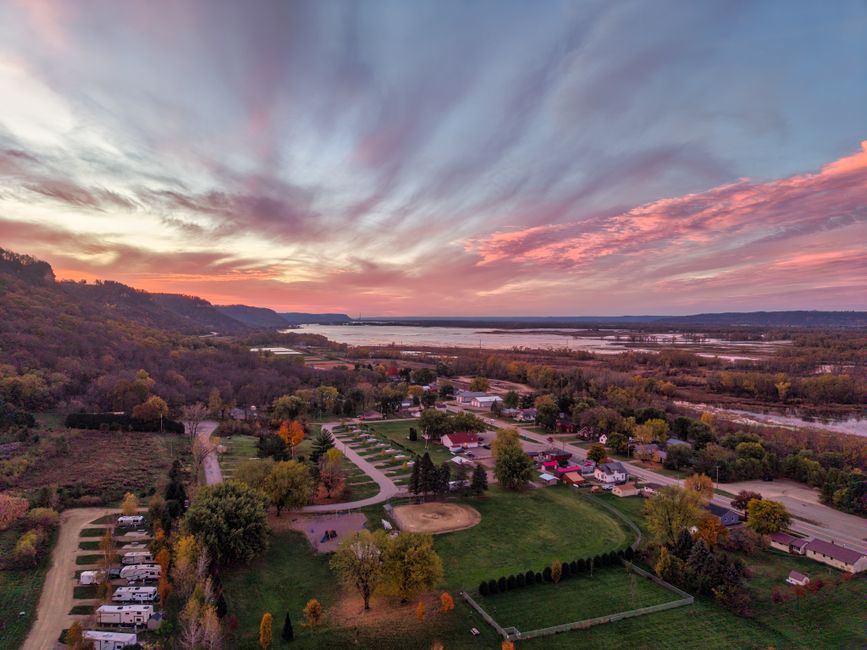
Stockton is one of Hunterdon County's smallest boroughs, with fewer than 500 residents in just over half a square mile, sitting on the Delaware River at the western edge of the Amwell Valley across from Pennsylvania's Solebury Township. It was renamed in 1851 to honor U.S. Senator Robert Field Stockton, and grew around mills and quarries after the Belvidere Delaware Railroad arrived in 1852. For water testing, the story is small numbers: NJDEP has recorded so few private well tests here that it will not publish a summary, and roughly four-fifths of the borough is inside a mapped public water service area.
The numbers Stockton does not have
The state withholds well-test summaries for any municipality with fewer than ten reported tests, and Stockton, with fewer than 500 residents, is one of them. Between September 2002 and December 2024, fewer than ten of the borough's wells went through a sale or rental test that reached NJDEP. Neighboring Delaware Township recorded 700. In a borough this small the low count is partly just arithmetic, and partly a sign that most properties are not on wells. It cannot be read as a statement about water quality.
Public water or a private well?
On NJDEP's 2017 purveyor map, about 79.9% of the borough lies inside the Stockton water system's service area, which the state lists as Stockton WD. That leaves roughly a fifth unmapped. Being inside a mapped area does not prove a given house is connected, and being outside it does not prove the opposite. A property at the edge could go either way, which is why the address matters more than the borough.
How to check your water source, step by step
Start with the paperwork and end with the hardware. Ask the seller for a recent bill from the borough water system, since that is the simplest proof of a public connection. Ask whether the property has, or ever had, a well, and for any driller's report or earlier test results. Then look for the physical signs: a well cap in the yard, a pressure tank in the basement, or filters and softeners on the incoming line. If the borough confirms the address is on its system, there is no PWTA test. If it is a well, the county's full panel applies, so it is worth knowing before a contract sets a deadline.
The rock beneath Stockton
The NJ Geological Survey's generalized map puts essentially the whole borough, about 98%, on Triassic siltstone, shale, sandstone and conglomerate, the Newark Basin's sedimentary rock. Across Hunterdon's Newark Basin towns, about 22% of wells exceed New Jersey's arsenic limit and about 7% exceed the gross alpha limit. Next door, Delaware Township records 21.7% above the arsenic limit and 11.7% above gross alpha. That is regional context and not a Stockton result, but it explains why those two lines deserve attention if a Stockton property turns out to have a well.
Buying or selling in Stockton
A borough system connection ends the PWTA question. A private well brings in the whole county panel, and here is how to approach it.
- Establish the source first. It decides whether the requirement applies and shapes the timeline.
- Treat Delaware Township as context, not a forecast. Its record is large, but a borough well has its own depth and surroundings.
- Gather every scrap of paperwork. With so little published data, the property's own history is the benchmark.
The sampling and analysis go through an NJDEP-certified laboratory or its authorized representative. Buyer and seller each see the results before closing, and the contract decides who pays. See the PWTA page.
Renting out a property in Stockton
Rental properties served by a private well need a retest at least every five years, with a written copy to each tenant within 30 days. Borough water customers have no such obligation. See landlord testing.
How this compares with neighboring towns
Percent of tested wells above the limit for arsenic and gross alpha, or outside the optimum pH range, with the number of wells behind each figure:
- Delaware Township: arsenic 21.7%, pH 24%, gross alpha 11.7% (700 wells)
Questions from Stockton homeowners
What does a blank on the state's map mean?
That fewer than ten tests were on file. In a borough with under 500 residents that is unsurprising, and it says nothing about the water.
If I am not selling, how often should I test?
The New Jersey Department of Health encourages well owners to test every year for total coliform, nitrate and pH, and at least once for arsenic, mercury, gross alpha and uranium. On public water the utility tests what it delivers, and NJDEP's NJ Water Check database publishes the results.
Can I see other homeowners' results?
No. NJDEP releases results only as summaries by county, municipality, census block group and 2-by-2-mile grid, without names or addresses, and withholds any area with fewer than ten tests. A property's own paperwork is the best local record.
Is a well near the river more likely to have problems?
The PWTA test does not change for river proximity, but flooding is a separate concern. Floodwater can contaminate a well, and testing after a flood is worth doing even without a sale.
Will a Stockton well need the uranium test?
Yes, uranium is on the panel for every well in Hunterdon County. See why the county requires it.