Well Water Testing in Union Township, NJ
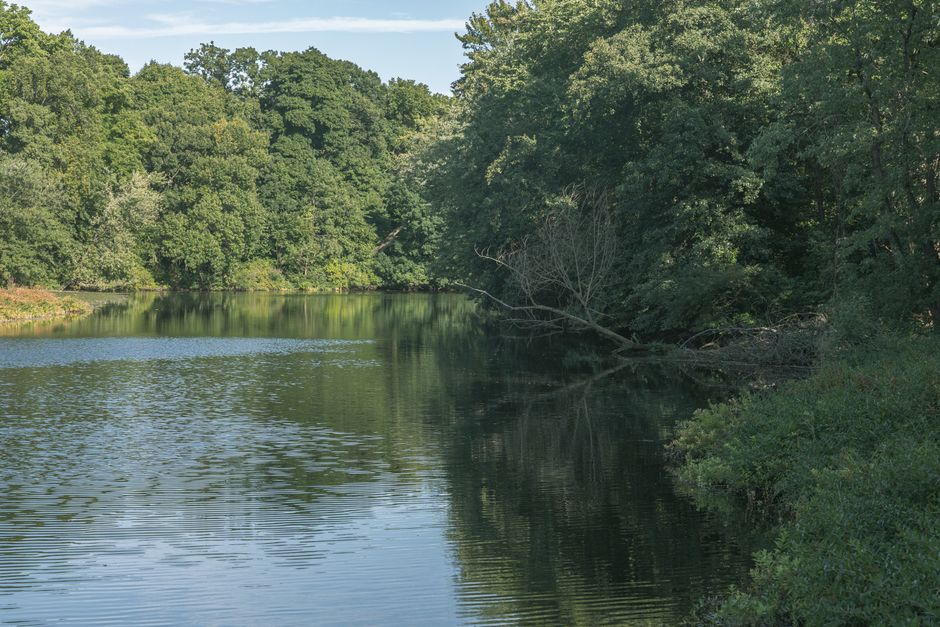
Union Township takes its name from Union Furnace, which produced cannonballs during the Revolutionary War and horseshoes and ox shoes into the 1780s. About 6,500 people live across nearly 21 square miles, and almost all of the township is on private wells: NJDEP's records show 616 tests since 2002 and only a small fraction of the land inside a mapped public water service area. What sets Union apart is its mix of rock. It is one of the few Hunterdon municipalities where four different kinds of bedrock each cover a meaningful share, and the wells show it.
What well tests in Union Township have found
NJDEP's Private Well Testing Act summary (September 2002 to December 2024) covers 616 untreated wells.
- pH: 43.9% of wells were outside the optimum range (county: 28.1%), closer to the Highlands towns than the Newark Basin ones.
- Arsenic: 6.5% exceeded the limit, well below the county's 15.7% and the Newark Basin towns' 22% average, but above the Highlands towns.
- Gross alpha: 0.5% of 566 wells exceeded the limit, the lowest of any Hunterdon township (county: 5.8%).
- Iron and manganese: 20.3% and 10% (county: 16% and 10.9%).
- Bacteria: total coliform in 25.4%; E. coli in 3.1%.
- Uranium: 0.5% of 198 wells; PFAS: 2.2% of 93 wells tested since late 2021.
- Nitrate and solvents: 1.3% and 0.2%.
The rock beneath Union Township
The NJ Geological Survey's generalized map divides the township roughly as follows: 46% Triassic siltstone, shale, sandstone and conglomerate of the Newark Basin; 33% Ordovician shale and limestone; 12% Precambrian gneiss and granite of the Highlands; and 8% Cambrian limestone and sandstone. That is a cross-section of the geology that shapes well water across the county, in one township. It fits the results: the pH rate is high like the Highlands, the arsenic rate is in between, and gross alpha is remarkably low. Which side of the township a property sits on is the best predictor of its result, and our post on why wells differ covers the reasoning.
Public water or a private well?
NJDEP's 2017 purveyor map shows about 7.7% of the township inside a mapped service area, mostly the reach of the Clinton water system and a state correctional facility's system. For the rest, the answer is a private well. Nearby Clinton is mostly on public water, which makes the boundary worth checking for properties near the town line.
Reading a neighbor's result
In a township with mixed rock, the usual habit of asking a neighbor how their water tested is less reliable than elsewhere. The neighbors' well may draw from a different rock than yours, at a different depth, and the two can produce results that look nothing alike. A neighbor's test is a hint about the neighborhood, not a prediction for your house. The useful questions are how deep the well is, whether the neighbor has treatment equipment, and which part of the township the property is in, because those details tell you how much the result applies.
Buying or selling in Union Township
Because the rock changes across the township, sellers do best to avoid assumptions.
- Find out what the neighbors have seen, carefully. A neighbor's result is only a guide within the same rock. A well a mile away may draw on something different.
- Expect pH to be the most likely flag, with arsenic a real possibility.
- Gross alpha is unlikely to be an issue. Its low rate here is one of the better results in the county.
Both parties must receive and review the results before closing, and the contract decides who pays. See the PWTA page and the buyer's guide.
Renting out a property in Union Township
Landlords on private wells retest at least every five years and give each tenant a copy within 30 days of the result. A test from before December 2021 will not include PFAS. See landlord testing.
How this compares with neighboring towns
Percent of tested wells above the limit for arsenic and gross alpha, or outside the optimum pH range, with the number of wells behind each figure:
- Lebanon Township: arsenic 0.6%, pH 54.4%, gross alpha 2.8% (1,084 wells)
- Clinton Township: arsenic 3.6%, pH 40.3%, gross alpha 7.7% (928 wells)
- Alexandria Township: arsenic 23.5%, pH 34.4%, gross alpha 1.5% (863 wells)
- Franklin Township: arsenic 7.7%, pH 31.7%, gross alpha 5.1% (588 wells)
Questions from Union Township homeowners
Why do results vary so much within one township?
Because the bedrock changes across it. Four rock types each cover a real share of the land, and each behaves differently.
What should I ask the seller?
Ask for any earlier test reports, the depth and age of the well, and details of any treatment equipment. In a township where results vary across the land, those facts explain a report better than the township average does.
Is low gross alpha a guarantee?
No. It is a strong local tendency, not a promise for a specific well. The test decides.
If I am not selling, how often should I test?
The New Jersey Department of Health encourages well owners to test every year for total coliform, nitrate and pH, and at least once for arsenic, mercury, gross alpha and uranium. An owner in a mixed-rock township has particular reason to test once, since a neighbor's result is a weaker guide here than elsewhere.
Do I need uranium testing?
Yes, for a well; 0.5% of 198 local wells exceeded the limit. See why Hunterdon requires it.